Ryan Carter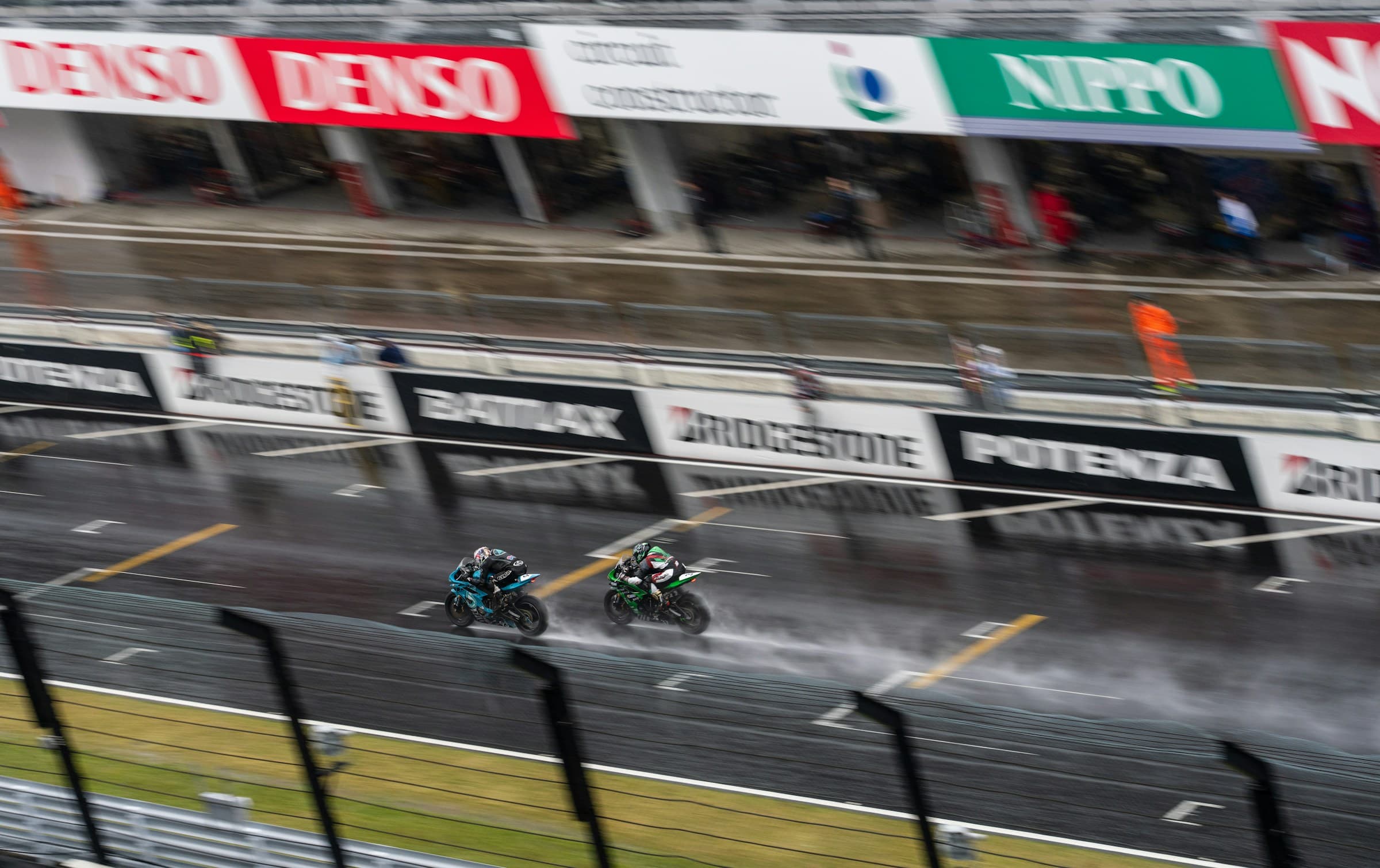
From the driver's seat of any of those 22 machines, a sinkhole in the main straight isn't a logistical inconvenience — it's the scenario every rider hopes never materializes. Goiânia's main straight opened up Saturday afternoon: one meter wide, 2.5 meters long, workers in up to their waists while the MotoGP grid sat in parc fermé. Eighty minutes later, Marc Márquez crossed the line first. But the most interesting race of the weekend wasn't the 15-lap sprint — it was the string of documented evidence that had spent three days announcing exactly what was about to happen.
The Sinkhole That Stopped a World Championship
Heavy rainfall across the Goiás region saturated the subsoil and washed out the substrate beneath brand-new asphalt — less than a year old. This wasn't a burst pipe or a localized void. The ground simply lost cohesion under a surface that hadn't had time to bond properly with what was below.
Workers moved in with disc cutters to remove the affected tarmac section, compacted gravel fill, and laid fresh surface. FIM MotoGP safety commissioner Tomé Alfonso confirmed the sinkhole was "outside the racing line" before clearing the track. Moto2 qualifying was bumped to Sunday morning at 9:40 AM. The sprint eventually fired up at 4:20 PM UTC-3.
| Parameter | Detail |
|---|---|
| Sinkhole dimensions | ~1m wide × 2.5m long |
| Sprint delay | 80 minutes |
| New start time | 4:20 PM UTC-3 |
| Rescheduled session | Moto2 qualifying (Sunday, 9:40 AM) |
Here's what the spec sheet won't tell you: if the main straight has a subsurface cavity, nobody has a clean answer for what's underneath the remaining 3.835 km of circuit. That question was hanging over the paddock long after the sprint wrapped up.
Márquez and the Art of Winning Ugly
Márquez arrived in Brazil as defending champion but 23 points down — direct fallout from the rear puncture he suffered in the closing laps of the Thailand GP. Mechanical incidents detonate championships that get decided by individual points, and Thailand was exactly that kind of race.
Fabio Di Giannantonio launched from pole and built a 1.4-second gap over the field through the early laps. Márquez closed it systematically across all 15 laps. On the final lap, Di Giannantonio made an error coming onto the main straight.
The mistake Márquez had been setting up all race.
First win of 2026.
Jorge Martín (Aprilia) completed the podium in third — his first sprint result for the Italian manufacturer, and further evidence that the RS-GP has genuine race pace this season. Bagnaia finished eighth, the only front-runner who gambled on the medium rear tire. In a 15-lap sprint where the field ran soft, that's either brilliant degradation management or a miscalculation — Sunday's full race will answer it.
Diogo Moreira crossed the line tenth. Brazilian rider, home grand prix, scoring points on a Honda. Some details don't show up in lap times.
Acosta's 2-Point Tightrope: Championship Standing
What's ninth place worth when you're leading the championship, rain is forecast for Sunday, and the main straight has been patched for three hours? For Pedro Acosta, exactly one point — and the smallest margin of the season.
The sprint cut his lead to a season-low. Championship standings after the sprint:
| Rider | Team | Sprint result | Championship |
|---|---|---|---|
| Pedro Acosta | Red Bull KTM | 9th (1 pt) | Leader — 2 pts over Bezzecchi |
| Marco Bezzecchi | Aprilia | 4th | 2 points off the lead |
| Marc Márquez | Ducati Gresini | 1st | Closing fast |
| Fabio Di Giannantonio | VR46 Ducati | 2nd | Level with Márquez |
| Jorge Martín | Aprilia | 3rd | Consistent across two rounds |
| Francesco Bagnaia | Ducati Factory | 8th | Medium tire — strategic gamble |
Acosta hasn't won yet in 2026. Bezzecchi took Thailand. With rain in the forecast and the main straight having been repaired that same afternoon, Sunday's full race arrives loaded with uncertainty. The championship is exactly as open as those numbers suggest.
Bagnaia Called It — Nobody Listened
Thursday, March 19. Two days before the sinkhole. MotoMatters' paddock analysis noted water filtering through the new asphalt from below due to saturated ground. Service roads were full of mud and potholes. Restrooms were still under construction while free practice sessions ran meters from the building work.
Bagnaia was blunt: "I just hope it doesn't rain, because if it rains, we'll have a massive problem in Sector 1 and Sector 4." It rained Saturday. The straight opened up. Riders don't warn about specific sectors unless they've put their boots on that tarmac and measured something that genuinely worries them.
The timeline is documented:
- December 2024: Dorna and Brasil Motorsport sign a five-year deal (2026–2030). The State of Goiás commits R$55 million to renovations: full new asphalt, paddock modernization, and upgraded medical facilities.
- Preference ignored: According to Paddock GP, the circuit itself preferred to wait until 2027. Neil Hodgson put it plainly: "We arrived six months too early."
- Thursday, March 19: Water filtering under the new tarmac. Muddy service roads. Unfinished restrooms during an active event.
- Friday: Rain delays morning sessions.
- Saturday, March 21 — post-MotoGP qualifying: Main straight opens up.
I haven't reviewed the contractual terms between Dorna and Brasil Motorsport, so I can't confirm which homologation clauses were signed or who signed off on the circuit's readiness for debut. But R$55 million in renovations and a documented water infiltration problem on Thursday make it very difficult to argue the sinkhole was unforeseeable.
In my years as a racing instructor, I kept one rule consistent: when a track surface is warning you, you listen. Goiânia spent three days sending those warnings. The championship listened on Saturday afternoon — 80 minutes later than scheduled.
Did Dorna Jump the Gun on Brazil?
Goiânia last hosted MotoGP in 1989 — a 37-year gap. Brazil as a whole hadn't had a premier-class grand prix since Jacarepaguá, Rio, in 2004. Twenty-two years. The commercial logic for Dorna is obvious. The sporting logic is where things get complicated.
The Autódromo Internacional Ayrton Senna measures 3.835 km — second shortest on the calendar, comparable to Sachsenring. On a circuit that compact, every meter of tarmac carries proportionally more consequence. The R$55 million covered full new asphalt, paddock renovation, and medical facilities. The new asphalt produced the sinkhole; the paddock arrived with restrooms half-finished.
It's frustrating that in 2026, a world championship can sign a five-year contract and show up to round one with construction crews still active inside the venue. That's not ambitious scheduling — that's a homologation process that either didn't ask the hard questions or didn't act on the answers it received.
The circuit itself wanted to wait until 2027. That preference was overruled. The result was 80 minutes of a world championship on hold while workers filled a hole with gravel.
Four editions of the contract remain. Whether Goiânia can return in 2027 with the underlying substrate issues genuinely resolved — not just patched at the surface — is the question Dorna and Brasil Motorsport owe riders and fans an honest answer on before this round comes back.
Real talk: the on-track product was excellent. Márquez winning ugly, Acosta grinding for a single point, Martín quietly building momentum on the Aprilia — the championship drama is real. But a world-class circuit has to be structurally ready before the gates open, not patched during the event itself. As our Ducati Sepang analysis covered, reliability gaps in this championship have outsized consequences. At Goiânia, the reliability gap wasn't in the bikes. The sinkhole is the symptom. The contract timeline is the problem.