Tom Jennings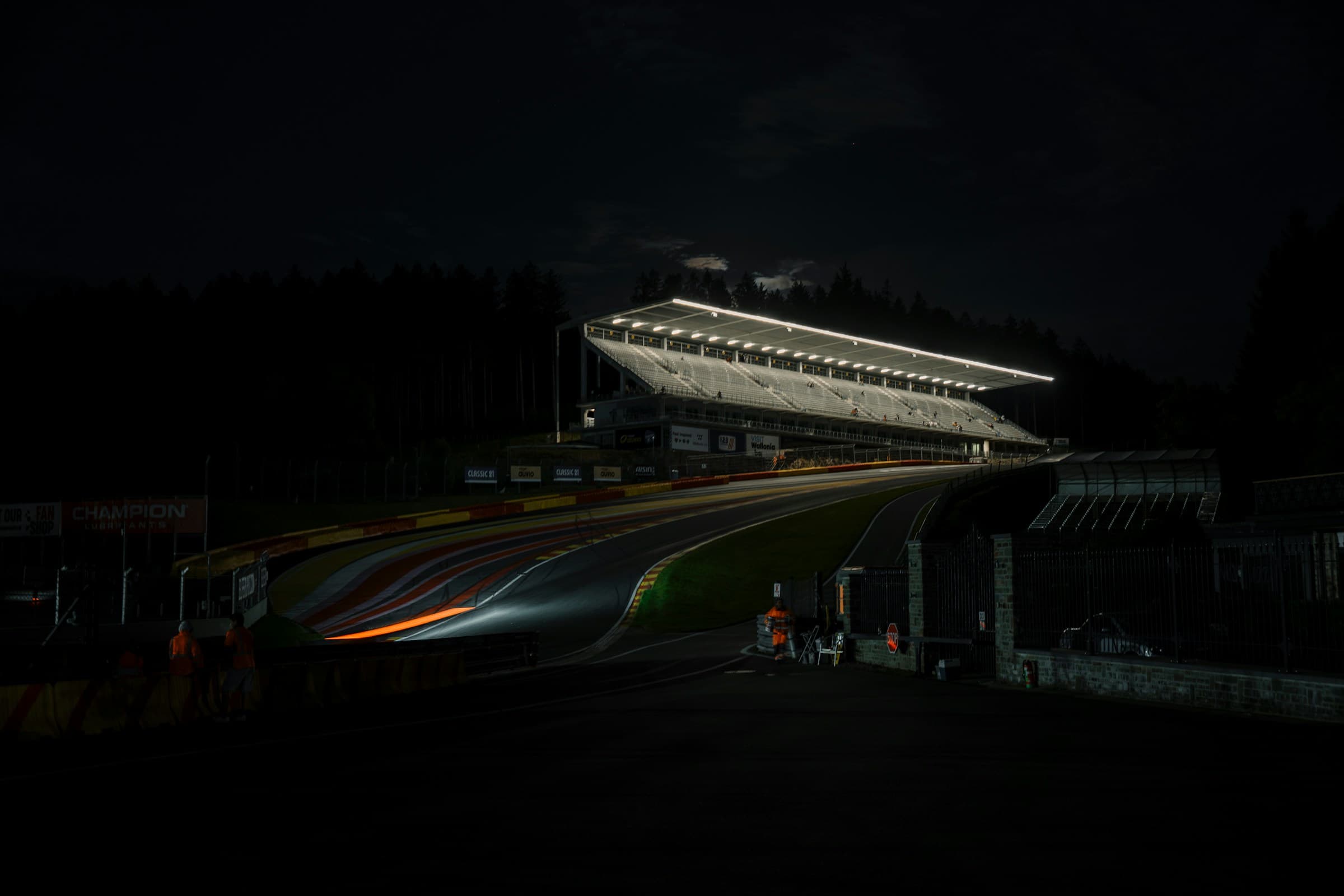
The thermal gap nobody's talking about
Losail has lights. MotoGP installed permanent floodlighting in 2008, so infrastructure exists. What doesn't exist: six hours of WEC endurance data under those lights.
The problem isn't illumination—it's thermodynamics. November nights in Qatar drop from 95°F (twilight) to 72°F (midnight). That 23-degree swing doesn't just affect driver comfort. It rewrites three critical engineering domains: brake disc operating windows, tire contact patch pressure, and lithium-ion hybrid battery efficiency.
Under the skin, here's what changes:
Brake thermal windows narrow. Carbon disc brakes operate optimally between 1,380-1,740°F (disc surface temp). At 95°F ambient, Turn 1's 200-to-50 mph braking zone generates enough heat to stay in that window. At 72°F ambient, the same braking effort yields 1,420°F disc temps—lower edge of the window. You need more aggressive pad compound to generate initial bite, but not so aggressive that you overshoot thermal limits on the opening stint when ambient temps are still high. Calibrate for daytime conditions, your brakes won't bite at midnight. Calibrate for midnight, they'll overheat at race start.
Tire pressure maps drift. Michelin supplies WEC-spec compounds, but tire pressure is team-controlled. At 95°F ambient, cold pressure of 26 psi climbs to 30 psi hot (mid-stint). At 72°F ambient, that same 26 psi cold settles at 28 psi hot—you lose optimal contact patch geometry. Humidity compounds this: Losail November nights see relative humidity climb from 40% (day) to 65% (night), reducing asphalt chemical grip by roughly 8% according to FIA surface data.
Hybrid thermal management flips. LMH/LMDh Hypercars generate more waste heat than old LMP1s due to MGU-K energy recovery systems. At 95°F ambient, cooling systems run at maximum capacity to prevent battery overheating. At 72°F, cooling efficiency improves—but lithium-ion cells lose efficiency below 60°F core temp. You need to recalibrate deployment maps to avoid overcooling the battery pack during late-race stints.
| Parameter | Twilight (95°F) | Midnight (72°F) | Setup adjustment |
|---|---|---|---|
| Brake disc temp | 1,560°F optimal | 1,420°F low bite risk | +10% pad aggression |
| Tire pressure (hot) | 30 psi | 28 psi | -1.5 psi cold starting pressure |
| Hybrid efficiency | 88% (thermal limit) | 93% (optimal) | Remap deployment curve |
| Asphalt grip (humidity) | 100% (40% RH) | 92% (65% RH) | +0.5° rear wing angle |
Factory teams (Toyota, Ferrari, Porsche, Cadillac) can afford private night testing at other illuminated circuits. Privateers can't. They'll extrapolate from Bahrain's twilight format (only 2 hours nocturnal, not 6) or MotoGP Qatar data (45-minute sprint race, stable temps). That's not engineering—it's educated guessing.
What Sebring and Daytona taught us (and Qatar ignored)
Night endurance racing isn't new. Sebring's run partial-night formats since 1952. Daytona's been 24 hours (full night included) for decades. IMSA telemetry from 2015-2025 shows a consistent pattern: incident rates spike 18% during nocturnal hours versus daylight stints.
Root causes aren't mysterious:
- Driver visibility degradation (rival headlight reflections in mirrors)
- Crew fatigue (tire change times slow post-midnight)
- Telemetry reading errors (pit lane screens harder to parse under artificial light)
Bahrain's 8 Hours uses a twilight format (race starts at sunset, runs 2 nocturnal hours) specifically to mitigate these risks. The gradual day-to-night transition lets teams adjust setup incrementally. Daytona's 24 Hours includes a dawn phase that "wakes up" drivers physiologically.
Qatar 2026 will be six hours of pure night—no gradual transition, no dawn recovery phase. And with 24 Hypercars entered (12 factory, 12 privateer LMP2), the performance gap between teams with night simulation infrastructure and those guessing from Bahrain data will be wider than any other WEC round.
The factory advantage: simulator budgets vs. guesswork
Factory teams already have night-capable simulators with calibrated lighting models and thermal wind tunnel data for nocturnal conditions. Industry estimates put simulator infrastructure cost at $2.7M initial investment plus $430k/year maintenance.
Privateers don't have $2.7M lying around. A private night test at an illuminated circuit (Bahrain, Losail, COTA with temporary lighting) runs approximately $130k-$195k for an LMP2 team. That breaks down to:
- Track rental (nocturnal rate): ~$43k
- Fuel and tires (6-hour simulation): ~$27k
- Crew overtime (double shift): ~$16k
- Technical staff logistics (flights/hotels): ~$22k
- Post-test telemetry analysis: ~$22k
For a privateer team operating on a $6.5M/year budget, that's 3% of annual spend for one race. Most won't do it. They'll arrive in Qatar with setup based on Bahrain twilight data (which only covers 2 nocturnal hours, not 6) or MotoGP Qatar sprint race data (thermally stable, short duration).
It's like calibrating your Nürburgring brake setup using Monaco data—the physics don't translate.
For spectators, this means higher upset potential (privateers gambling on aggressive setups), more mechanical DNFs (brakes, transmission failures from thermal miscalibration), and probable factory dominance even more pronounced than usual.
Prime-time for Europe, dead zone for everyone else
The ACO (Automobile Club de l'Ouest) is selling Qatar night racing as "improved European TV accessibility." Race start at 6:00 PM local Qatar time translates to 3:00 PM CET Saturday—European prime-time sports viewing window. Better than dawn Asian races that air at 4:00 AM in Paris.
But let's check the actual global broadcast math:
- Japan (GMT+9): 10:00 PM - 4:00 AM
- China (GMT+8): 9:00 PM - 3:00 AM
- US East Coast (GMT-5): 9:00 AM - 3:00 PM (workday)
- US West Coast (GMT-8): 6:00 AM - 12:00 PM (early weekend)
"Prime-time for Asia" it is not. This is European prime-time disguised as global expansion.
On-site attendance adds another wrinkle. Qatar 2024's daytime WEC round drew 15,000 spectators (weekend total). Compare: Le Mans 60,000+, Monza 40,000. Qatar was already the lowest-attended WEC round. A night race may worsen local turnout—Qatari family culture favors daytime events, and 6:00 PM-midnight competes directly with dinner and social commitments. Plus, November 2026 overlaps with F1's season finale (Abu Dhabi GP typically late November), splitting global motorsport TV audience.
Visual spectacle for broadcast will be superior—artificial lighting creates dramatic car light contrast, night racing aesthetics are proven TV draws. But if operational costs push privateers out of the championship entirely (budgets can't absorb night testing plus added logistics), WEC risks becoming a factory-only show with 12 Hypercars instead of 24. That's not spectacle—that's a parade.
Why this experiment probably won't survive 2027
Under the skin, Qatar night racing is an engineering gamble with questionable commercial upside. Factory teams gain structural advantage via simulator infrastructure privateers can't match. TV ratings may improve in Europe, but global viewership math doesn't justify the "Asian expansion" narrative. On-site attendance will likely decline further from an already weak baseline.
I give it two years before WEC reverts to daytime or Bahrain-style twilight format. The thermal engineering challenges are solvable if you have factory budgets. The commercial contradictions aren't.
If you're a fan, watch 2026 closely—this format may not return. If you're a privateer engineer, budget an extra $160k and hope Bahrain twilight data extrapolates cleanly. If you're a driver, get used to braking with less grip than your muscle memory expects when track temps hit 72°F in stint four and your brain still thinks it's 95°F.
Welcome to WEC night racing. Nobody knows what'll happen—and that, at minimum, is honest.